
Specifications and workshop reference information for the 1983 Honda XR350, including engine, chassis, service data and setup details.
Note: Specs are compiled from factory data, manuals and owner feedback. Bikes vary — if yours is different, jump into the forum and share it.
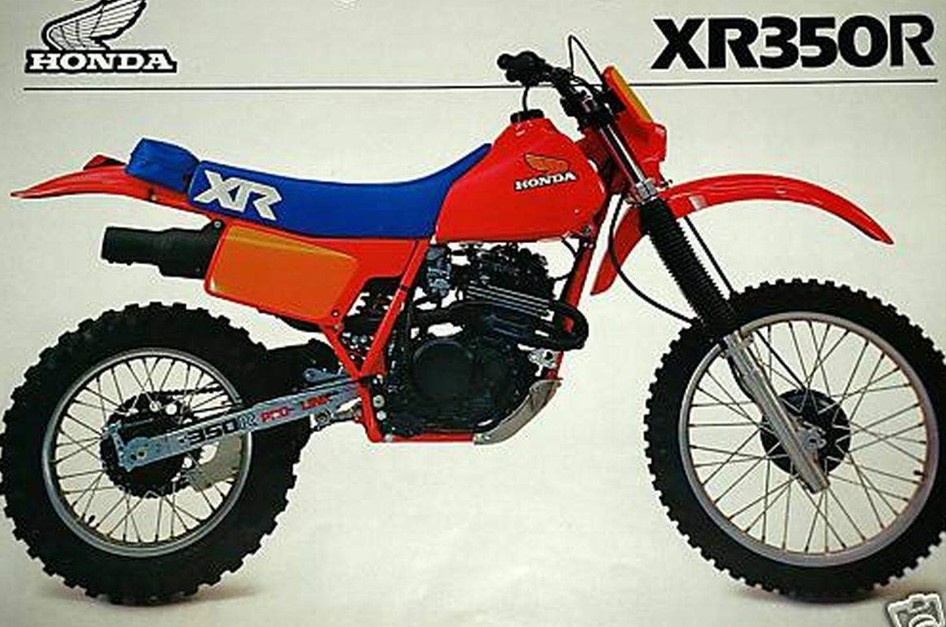
| Engine Type | Four-stroke, single cylinder SOHC, 4 valve |
| Displacement | 339 cc / 20.7 cu-in |
| Bore × Stroke | 84 × 61.3 mm |
| Compression Ratio | 9.5:1 |
| Maximum Power | 22 hp / 16.7 kW @ 7500 rpm |
| Maximum Torque | 25.7 Nm @ 7000 rpm |
| Carburetor | 2 × 26 mm Keihin carburetors | Replacement Options |
| Lubrication | Dry sump |
| Fuel Mix Ratio | Straight unleaded fuel |
| Ignition | CDI |
| Spark Plug | NGK DPR8EA-9 |
| Spark Plug Gap | 0.8 - 0.9 mm |
| Valve Clearance (Intake) | 0.05 mm |
| Valve Clearance (Exhaust) | 0.08 mm |
| Transmission Type | 6-speed |
| Clutch | Wet multi-plate |
| Final Reduction | Chain |
| Wheelbase | 1430 mm / 56.3 in |
| Ground Clearance | 320 mm / 12.6 in |
| Fuel Tank Capacity | 12 L / 3.2 US gal |
| Bearing Sizes | Bearing Finder |
| Frame Type | Full duplex cradle steel frame |
| Caster Angle | 26.5° |
| Trail | 116 mm / 4.5 in |
| Front Suspension | 41 mm Showa air adjustable forks | Fork Oil Levels |
| Rear Suspension | Single Showa gas shock, fully adjustable |
| Front Suspension Travel | 280 mm / 11 in |
| Rear Suspension Travel | 270 mm / 10.6 in |
| Front Tire | 90/90-21 | Tyre Size Guide |
| Rear Tire | 130/90-17 | Tyre Size Guide |
| Front Brake | Single disc |
| Rear Brake | Drum |
| 1974 Honda XL350 |
| 1975 Honda XL350 |
| 1976 Honda XL350 |
| 1977 Honda XL350 |
| 1978 Honda XL350 |
| 1984 Honda XR350 |
| 1985 Honda XR350 |
| 1958 AJS 350-Metisse |
| 1975 Ossa 350-Phantom |
The 1983 Honda XR350R arrived at an important point in Honda’s off-road history. Riders who liked the manageable size of the XR250 often wanted more power, while the larger XR500 could feel like a lot of motorcycle in tight going. Honda’s answer was a completely new middleweight: the 339cc XR350R, combining serious four-stroke torque with a lighter, more agile chassis. Contemporary testing praised exactly that balance, describing the XR350R as substantially lighter and more responsive than Honda’s earlier big-bore four-strokes.
The real technical headline was the new RFVC — Radial Four Valve Combustion Chamber — cylinder head. Instead of arranging the four valves conventionally, Honda positioned them radially around the combustion chamber. Combined with an oversquare 84 x 61.3mm bore and stroke, the design allowed the engine to breathe and rev far more freely than many traditional four-stroke singles of the period. The 1983 engine displaced 339cc and used a six-speed gearbox.
Fuel was delivered through a pair of progressive Keihin carburettors. For today’s owner, these twin-carburettor systems deserve careful attention. Hardened seals, blocked pilot circuits, incorrect float levels or poorly synchronised operation can make an otherwise healthy XR difficult to start or unpleasant at low throttle. Before blaming ignition or compression, thoroughly inspect and service the twin Keihin carburettor system. The original 1983 machine also used twin exhaust header pipes, making the cylinder head and induction arrangement visually distinctive.
Honda also gave the XR350R proper off-road suspension. At the front were 41mm Showa forks, while the rear used Honda’s rising-rate Pro-Link system with a gas-charged Showa shock offering compression and rebound adjustment. Riders restoring one today should resist simply replacing seals and calling the suspension finished. Correct oil quantity and condition can transform an old fork, making the VMXOwners fork oil reference useful when servicing ageing suspension. At the rear, checking linkage bearings, shock condition, spring preload and sag is equally important; the rear suspension setup and sag guide provides a useful starting point.
One detail that separates the first-year XR350R from later versions is the front brake. The 1983 model retained a mechanical drum, while Honda moved to a hydraulic front disc for 1984. That makes an original 1983 machine easy to recognise and also means brake condition deserves particular attention on a bike intended for regular riding.
Owners should also inspect the chassis carefully. Australian retrospective coverage of the XR350R specifically warns about cracking around the footpeg mounting area on bikes that have seen hard use or repeated jumping. Steering-head, swingarm and wheel bearings are also worth checking rather than assuming forty-year-old components remain serviceable; the VMXOwners motorcycle bearing finder can help when replacement time arrives.
Today the 1983 XR350R occupies a fascinating place in Honda history. It was neither a mild trailbike nor an oversized open-class thumper. It introduced RFVC technology in a compact, genuinely capable off-road package and helped establish the architecture and thinking that would define Honda’s XR four-strokes for years to come. For vintage enduro, Vinduro and classic Honda enthusiasts, a well-sorted first-year XR350R remains one of the most interesting red four-strokes of the early 1980s.
Discuss vintage motocross bikes, restorations, tuning and riding.