
Specifications and workshop reference information for the 1981 Yamaha IT250, including engine, chassis, service data and setup details.
Note: Specs are compiled from factory data, manuals and owner feedback. Bikes vary — if yours is different, jump into the forum and share it.
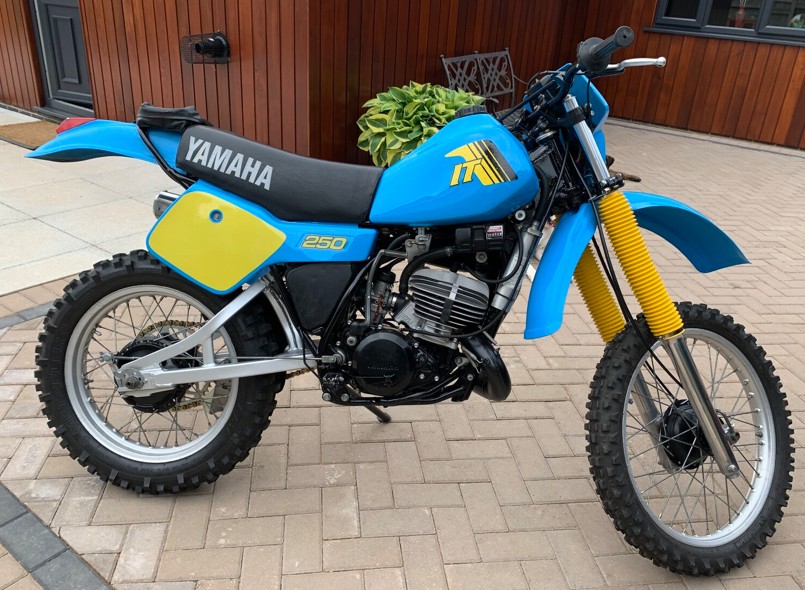
| Engine Type | Air-cooled, 2-stroke, single-cylinder |
| Displacement | 246 cc |
| Bore × Stroke | 70.0 × 64.0 mm |
| Compression Ratio | 6.8:1 |
| Maximum Power | Approx. 28 hp |
| Maximum Torque | |
| Carburetor | Mikuni | Replacement Options |
| Lubrication | Premix |
| Fuel Mix Ratio | 20:1 | Premix Calculator |
| Ignition | CDI |
| Spark Plug | NGK B8ES |
| Spark Plug Gap | 0.6–0.7 mm |
| Transmission Type | 6-speed manual |
| Clutch | Wet multi-plate |
| Final Reduction | Chain drive |
| Overall Length | 2,140 mm |
| Overall Width | 840 mm |
| Overall Height | 1,160 mm |
| Wheelbase | 1,440 mm |
| Ground Clearance | 300 mm |
| Fuel Tank Capacity | 9.5 L |
| Bearing Sizes | Bearing Finder |
| Frame Type | Steel single cradle |
| Front Suspension | Telescopic forks | Fork Oil Levels |
| Rear Suspension | Monoshock (Monocross) |
| Front Suspension Travel | |
| Rear Suspension Travel |
| Front Tire | 3.00-21 | Tyre Size Guide |
| Rear Tire | 4.50-18 | Tyre Size Guide |
| Front Brake | Drum brake |
| Rear Brake | Drum brake |
| 1972 Honda XL250-Motosport |
| 1976 Honda CR250M |
| 1980 Honda CR250 |
| 1983 Honda CR250 |
| 1986 Honda CR250 |
| 1983 Honda XL250 |
| 1984 Honda XL250 |
| 1985 Honda XL250 |
The 1981 Yamaha IT250 came from a period when Japanese manufacturers were rapidly transforming enduro motorcycles from modified trail bikes into serious competition machines. Yamaha’s IT range had already earned a strong following among enduro and cross-country riders, and the 250 combined genuine off-road performance with the durability and broader power delivery needed for long days in the bush.
At its heart was a 246 cc air-cooled two-stroke single. Unlike a motocross engine designed primarily to deliver maximum performance over relatively short races, the IT250 needed usable power across a wider range of conditions. Tight trees, slippery climbs, creek crossings and faster open sections could all appear during the same event. Yamaha tuned the engine accordingly, giving the IT strong, controllable performance without making it unnecessarily difficult to ride.
Today, carburettor condition is one of the first areas worth checking on a long-stored IT250. Old fuel residue, worn jets, incorrect float height or an air leak can produce poor starting and erratic running that is sometimes blamed on ignition problems. Owners rebuilding the original induction system can use the VMXOwners carburettor reference and replacement guide when identifying components and alternatives.
Being a two-stroke, correct fuel and oil preparation also remains important. Modern oils are considerably different from what riders had available in 1981, but the engine still needs an appropriate mixture for its state of tune and intended use. The VMXOwners two-stroke premix calculator makes it easy to calculate the required oil quantity when preparing fuel.
The IT250's chassis reflected Yamaha's considerable off-road competition experience. Long-travel suspension and Yamaha's Monocross rear suspension gave the bike the ability to tackle rough terrain at speeds that would have been punishing on earlier enduro machines. More than four decades later, however, suspension condition can make the difference between an IT that feels remarkably capable and one that feels completely worn out. Fresh fork oil, correct settings and inspection of seals, bushes and internal components should be high on any recommissioning list. The fork oil reference for vintage motorcycles is a useful starting point.
Final-drive condition also deserves attention. Enduro riding exposes chains and sprockets to mud, water, dust and repeated shock loads, and many surviving IT250s have been fitted with different gearing during their lives. Before replacing components, determine what sprocket combination is currently fitted and whether it suits the riding you intend to do. The VMXOwners chains and sprockets guide can help when sorting out replacement final-drive components.
What makes the 1981 IT250 particularly interesting today is that it sits in a sweet spot for vintage off-road riding. It has enough performance to be genuinely exciting, but it predates much of the complexity found on later machines. There are no radiators to damage, no electronic engine management and no elaborate starting systems.
For vinduro competition, trail riding or a period restoration, the 1981 Yamaha IT250 remains a fine example of the era when enduro motorcycles became purpose-built competition tools — tough enough for the bush, fast enough to race and simple enough for an owner to maintain in the shed.
Discuss vintage motocross bikes, restorations, tuning and riding.