
Specifications and workshop reference information for the 1977 Yamaha TT500, including engine, chassis, service data and setup details.
Note: Specs are compiled from factory data, manuals and owner feedback. Bikes vary — if yours is different, jump into the forum and share it.
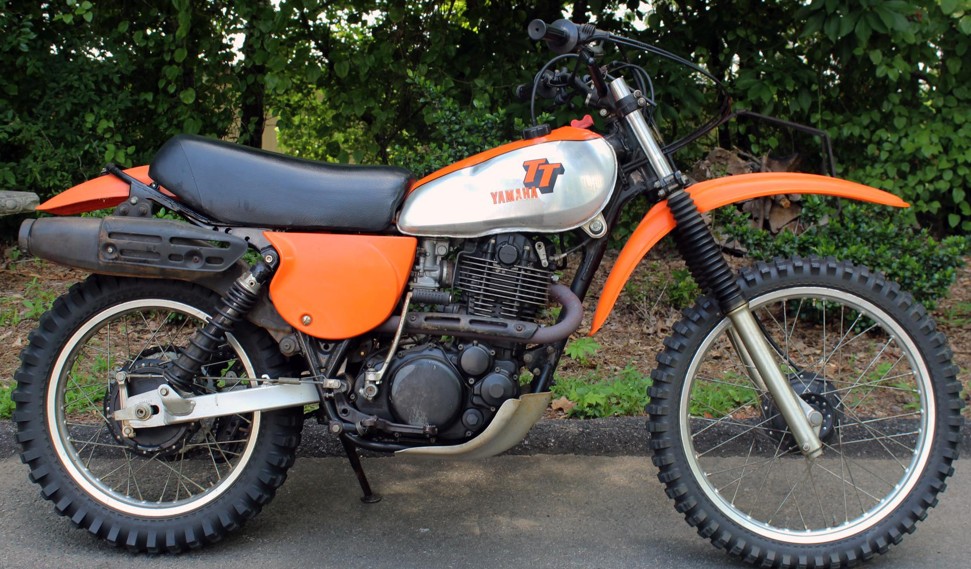
| Engine Type | Air-cooled, 4-stroke, single-cylinder, SOHC, 2-valve |
| Displacement | 499 cc |
| Bore × Stroke | 87.0 × 84.0 mm |
| Compression Ratio | 8.5:1 |
| Maximum Power | Approx. 32 hp |
| Maximum Torque | |
| Carburetor | Mikuni | Replacement Options |
| Lubrication | Dry sump |
| Fuel Mix Ratio | |
| Ignition | CDI |
| Spark Plug | NGK BP7ES |
| Spark Plug Gap | 0.6–0.7 mm |
| Valve Clearance (Intake) | 0.08 mm |
| Valve Clearance (Exhaust) | 0.10 mm |
| Transmission Type | 5-speed manual |
| Clutch | Wet multi-plate |
| Final Reduction | Chain drive |
| Overall Length | 2,200 mm |
| Overall Width | 880 mm |
| Overall Height | 1,180 mm |
| Wheelbase | 1,420 mm |
| Ground Clearance | 280 mm |
| Fuel Tank Capacity | 9.0 L |
| Bearing Sizes | Bearing Finder |
| Frame Type | Steel single cradle |
| Front Suspension | Telescopic forks | Fork Oil Levels |
| Rear Suspension | Dual shock swingarm |
| Front Suspension Travel | |
| Rear Suspension Travel |
| Front Tire | 3.00-21 | Tyre Size Guide |
| Rear Tire | 4.00-18 | Tyre Size Guide |
| Front Brake | Drum brake |
| Rear Brake | Drum brake |
| 1981 Honda XR500 |
| 1982 Honda XR500 |
| 1982 Honda XL500 |
| 1983 Honda XR500 |
| 1984 Honda XR500 |
| 1980 Honda XL500 |
The 1977 Yamaha TT500 arrived at a time when lightweight two-strokes dominated serious off-road competition. Yamaha went in the opposite direction, producing a large-capacity four-stroke single that relied on torque, simplicity and durability rather than high-rpm horsepower. Nearly fifty years later, that formula is exactly why the TT500 remains one of the most recognisable and desirable Japanese vintage off-road motorcycles.
The TT500 shared its basic 499 cc air-cooled, single-cylinder four-stroke engine architecture with Yamaha’s XT500, but the TT was aimed much more directly at off-road riding. The dry-sump engine carried its oil supply within the frame system, helping keep the engine compact while providing dependable lubrication during prolonged trail and competition use. Starting a big single could demand the correct technique, but once running the TT500 delivered the strong, steady power that became its trademark.
Rather than needing constant gear changes, the Yamaha could use its substantial low and mid-range torque to find traction and drive forward. That characteristic made the TT particularly effective in open-country events, desert racing, enduros and Australian-style trail riding. Riders learned to work with the motorcycle rather than attack every section with the aggressive style demanded by many contemporary two-strokes.
Fuel was delivered through a conventional Mikuni slide carburettor, a simple arrangement that remains relatively straightforward for restorers today. Correct jetting, float level and intake sealing are important on an old TT500, especially where previous owners have fitted aftermarket exhaust systems or modified airboxes.
The chassis was conventional for the period, with telescopic front forks, a steel frame and twin-shock rear suspension. By modern standards suspension travel and damping were limited, and the TT carried considerably more weight than a contemporary motocross two-stroke. However, the Yamaha’s predictable steering and planted feel helped it build a reputation for being extremely capable when ridden smoothly.
For owners restoring a TT500 today, originality is becoming increasingly important. Tanks, side covers, exhaust components and other model-specific pieces can be much harder to locate than basic engine service parts. Original TT500 fuel tanks and replacement options deserve particular attention because surviving tanks have often suffered decades of dents, corrosion, repairs or inappropriate repainting.
The drivetrain also deserves inspection before regular riding. Years of dirt, neglected lubrication and incorrect gearing can leave sprockets hooked and chains stretched, making the VMXOwners motorcycle chains and sprockets guide useful when returning an old machine to service.
The TT500’s historical importance extends far beyond one model year. Yamaha proved that the big four-stroke single still had a place in serious off-road motorcycling, and modified TT and XT engines went on to achieve impressive results in long-distance desert competition. The concept ultimately helped lay foundations for later generations of large-capacity four-stroke trail and enduro motorcycles.
A well-sorted 1977 TT500 is not the lightest or fastest vintage dirt bike, but that misses the point. Its appeal lies in its mechanical simplicity, unmistakable exhaust note, enormous character and ability to produce useful traction almost anywhere. For many vintage Yamaha enthusiasts, the TT500 represents the moment the traditional big-bore thumper found a new life.
Discuss vintage motocross bikes, restorations, tuning and riding.