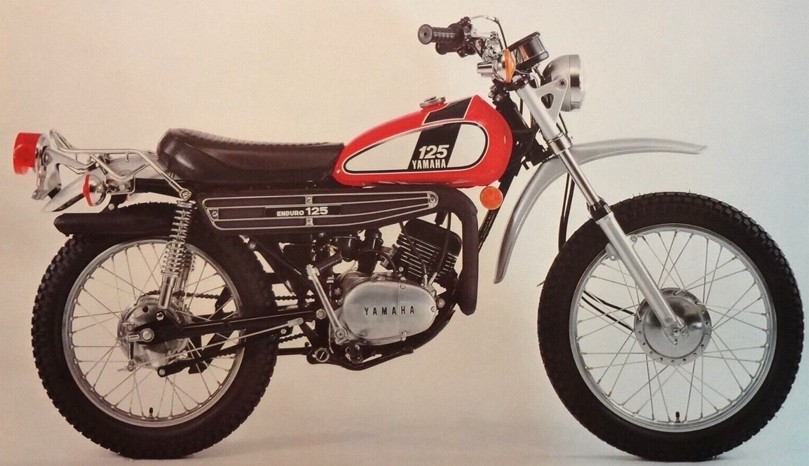
Specifications and workshop reference information for the 1975 Yamaha DT125B, including engine, chassis, service data and setup details.
Note: Specs are compiled from factory data, manuals and owner feedback. Bikes vary — if yours is different, jump into the forum and share it.
| Engine Type | Air-cooled, 2-stroke, single-cylinder, piston port |
| Displacement | 123 cc |
| Bore × Stroke | 56.0 × 50.0 mm |
| Compression Ratio | 6.9:1 |
| Maximum Power | Approx. 12 hp @ 7500 rpm |
| Maximum Torque | Approx. 14 Nm @ 7000 rpm |
| Carburetor | Mikuni VM24 | Replacement Options |
| Lubrication | Autolube oil injection |
| Fuel Mix Ratio | N/A (oil injection) |
| Ignition | Magneto (points) |
| Spark Plug | NGK B7ES |
| Spark Plug Gap | 0.6 – 0.7 mm |
| Transmission Type | 5-speed manual |
| Clutch | Wet multi-plate |
| Primary Reduction | Approx. 3.409 |
| Final Reduction | Approx. 3.000 |
| Overall Reduction | Varies by gear |
| Overall Length | Approx. 2050 mm |
| Overall Width | Approx. 820 mm |
| Overall Height | Approx. 1100 mm |
| Wheelbase | Approx. 1320 mm |
| Ground Clearance | Approx. 240 mm |
| Fuel Tank Capacity | Approx. 8.0 L |
| Bearing Sizes | Bearing Finder |
| Frame Type | Steel tubular, double cradle |
| Caster Angle | Approx. 28° |
| Trail | Approx. 110 mm |
| Front Suspension | Telescopic fork | Fork Oil Levels |
| Rear Suspension | Twin shock swingarm |
| Front Suspension Travel | Approx. 170 mm |
| Rear Suspension Travel | Approx. 100 mm |
| Front Tire | 2.75-21 | Tyre Size Guide |
| Rear Tire | 3.50-18 | Tyre Size Guide |
| Front Brake | Drum |
| Rear Brake | Drum |
| 1973 Kawasaki KX125 |
| 1974 Kawasaki KX125 |
| 1974 Yamaha YZ125 |
The 1975 Yamaha DT125B came from an era when a small-capacity trail bike was expected to do almost everything. It had to get its owner to work or school during the week, tackle fire trails on the weekend and survive the occasional enthusiastic attempt at motocross. Yamaha’s DT range had already established a strong reputation by the mid-1970s, and the DT125B offered much of that character in a lighter, approachable package.
At its heart was Yamaha’s air-cooled 125-class two-stroke single. The engine was simple, responsive and well suited to riders learning how to use a two-stroke effectively. Yamaha’s Autolube oil-injection system was another important feature of the period, removing the need for owners to manually premix fuel during normal road and trail use. On bikes where the original oil-injection equipment has been removed, owners converting to premix should make sure the fuel-to-oil ratio is appropriate; the VMXOwners two-stroke premix calculator can be useful when setting up a restored or modified machine.
The DT125B was never intended to be a pure motocross racer, but its relatively light weight, conventional telescopic forks and twin-shock rear suspension made it an entertaining trail bike. Modern owners should remember that suspension condition matters far more than simply fitting stiffer springs. Old fork oil, worn seals, rusty damper components and dry swingarm bushes can completely change the way one of these bikes handles. Checking the correct fork oil setup for vintage motorcycles is a sensible part of any DT125B recommissioning.
Carburetion is another area where forty-plus years of ownership can create problems. Many surviving DT125Bs have been fitted with different jets, replacement carburettors, pod filters or modified exhausts. Before chasing jetting problems, confirm exactly which carburettor is fitted and check the pilot circuit, float level, needle condition and for air leaks around the intake. The VMXOwners vintage motorcycle carburettor reference provides a useful starting point when identifying or troubleshooting older carburettor systems.
The chassis also deserves careful inspection. Steering-head, wheel and swingarm bearings on a trail bike often experienced water, mud and pressure washing long before anyone thought about preserving the machine for vintage use. Replacing tired bearings can make an enormous difference to steering feel and stability, and the VMXOwners Bearing Finder can help when original Yamaha part numbers are difficult to cross-reference.
What makes the 1975 DT125B particularly appealing today is its honesty. It is small, mechanically straightforward and does not require race-bike levels of commitment to enjoy. A properly sorted example is equally at home on a vintage trail ride, around a paddock or simply being preserved as a reminder of Yamaha’s enormously successful DT era.
For riders who grew up when a 125 trail bike represented freedom, the DT125B is more than an old motorcycle. It is a snapshot of the time when one bike, a basic toolkit and a tank of fuel could provide an entire weekend’s entertainment.
Discuss vintage motocross bikes, restorations, tuning and riding.