
Specifications and workshop reference information for the 1968 Yamaha DT1 250, including engine, chassis, service data and setup details.
Note: Specs are compiled from factory data, manuals and owner feedback. Bikes vary — if yours is different, jump into the forum and share it.
| Engine Type | Air-cooled, 2-stroke, single-cylinder, piston port |
| Displacement | 246 cc |
| Bore × Stroke | 70 mm × 64 mm |
| Compression Ratio | 6.4:1 |
| Maximum Power | 22.8 hp @ 7,000 rpm |
| Maximum Torque | 23.7 Nm @ 6,500 rpm |
| Carburetor | Mikuni VM26 | Replacement Options |
| Lubrication | Yamaha Autolube |
| Fuel Mix Ratio | N/A - oil injection |
| Ignition | Flywheel magneto |
| Spark Plug | N/A |
| Spark Plug Gap | N/A |
| Transmission Type | 5-speed manual |
| Clutch | Wet multi-plate |
| Primary Reduction | N/A |
| Final Reduction | 15 / 44 |
| Overall Reduction | N/A |
| Overall Length | 2060 mm |
| Overall Width | 890 mm |
| Overall Height | 1130 mm |
| Wheelbase | 1360 mm |
| Ground Clearance | N/A |
| Fuel Tank Capacity | 9.5 L |
| Bearing Sizes | Bearing Finder |
| Frame Type | Duplex cradle steel |
| Caster Angle | N/A |
| Trail | N/A |
| Front Suspension | Telescopic fork | Fork Oil Levels |
| Rear Suspension | Twin shock swingarm |
| Front Suspension Travel | N/A |
| Rear Suspension Travel | N/A |
| Front Tire | 3.25 × 19 | Tyre Size Guide |
| Rear Tire | 4.00 × 18 | Tyre Size Guide |
| Front Brake | Drum |
| Rear Brake | Drum |
| 1971 Rickman Montesa 250 |
| 1971 Yamaha DT1E 250 |
| 1972 Honda XL250 Motosport |
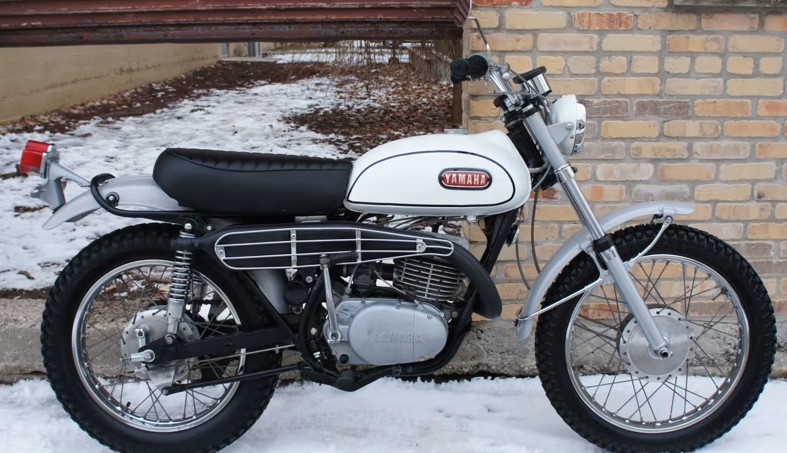
When Yamaha released the DT1 in 1968, it helped change the direction of off-road motorcycling. At a time when many riders were modifying road bikes or adapting heavier machines for dirt use, the DT1 arrived as a purpose-built 250 cc two-stroke that could be ridden on the road, taken onto trails and, with a few changes, used in competition.
Its success came from simplicity. The DT1 used a lightweight single-cylinder two-stroke engine, a conventional steel frame and long-travel suspension by the standards of the late 1960s. It was not a pure motocross machine, but it gave ordinary riders access to a motorcycle that felt far more at home in the dirt than most road-based alternatives. For many enthusiasts, it became the starting point for trail riding, enduros and early amateur motocross.
The engine was one of the DT1’s strengths. Two-strokes offered strong performance without excessive weight, and Yamaha’s Autolube oil-injection system meant road riders did not have to premix every tank. Competition owners often modified their engines and fuel systems, however, so anyone restoring or tuning an old DT1 should pay close attention to jetting, intake condition and the carburettor and fuel-system setup. A mechanically sound engine can still run poorly if the carburettor is worn, contaminated or incorrectly adjusted.
Suspension was basic compared with later motocross motorcycles, but the DT1 was an important step forward. Conventional telescopic forks and twin rear shocks gave the bike useful off-road ability while keeping maintenance straightforward. Restorers should inspect fork seals, damping condition, shock bushes and swingarm movement rather than assuming that old suspension is simply meant to feel soft. The VMXOwners fork oil reference guide can also be useful when servicing period conventional forks.
Final-drive condition matters just as much on an old DT1. Chain wear, hooked sprocket teeth and incorrect gearing can make a surprisingly large difference to how the bike feels on the trail. Before replacing parts, check the existing tooth counts and compare them with the intended type of riding. The chains and sprockets reference is a useful starting point when working through an ageing drive system.
Today, the 1968 DT1 is significant for more than its performance figures. It represents the point where Japanese manufacturers began offering affordable off-road motorcycles to a much wider audience. The model’s popularity encouraged Yamaha and its rivals to develop increasingly specialised trail, enduro and motocross machines throughout the 1970s.
For owners now, the best approach is usually sympathetic restoration rather than trying to make a DT1 behave like a modern dirt bike. Keep the engine healthy, make sure the brakes and controls work properly, service the suspension and preserve as many original components as practical. When replacement parts are needed, the VMXOwners vintage motorcycle Parts Finder can help track down suitable sources.
More than half a century later, the DT1 remains one of the motorcycles that helped define the modern trail-bike category—and one of Yamaha’s most important early off-road machines.
Discuss vintage motocross bikes, restorations, tuning and riding.